Monday, 27 January 2014

ROCKET MAIL PROGRAM LAUNCHES ENTIRE COLLECTION OF 1936 CANADIAN ROCKET-FLIGHT STAMPS: Fifth launch planned for spring 2014

ROCKET MAIL PROGRAM LAUNCHES ENTIRE COLLECTION OF 1936 CANADIAN ROCKET-FLIGHT STAMPS: Fifth launch planned for spring 2014


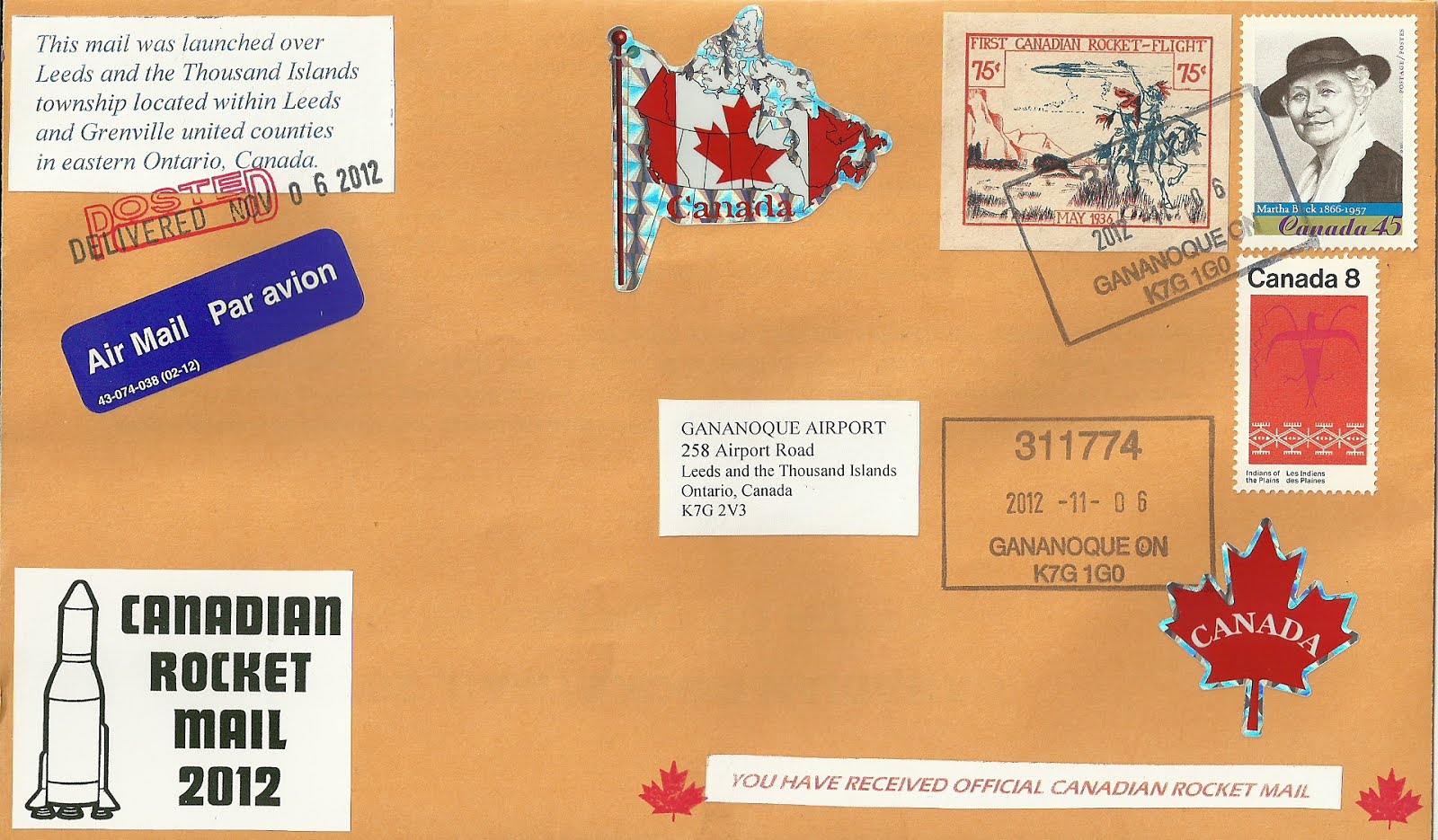
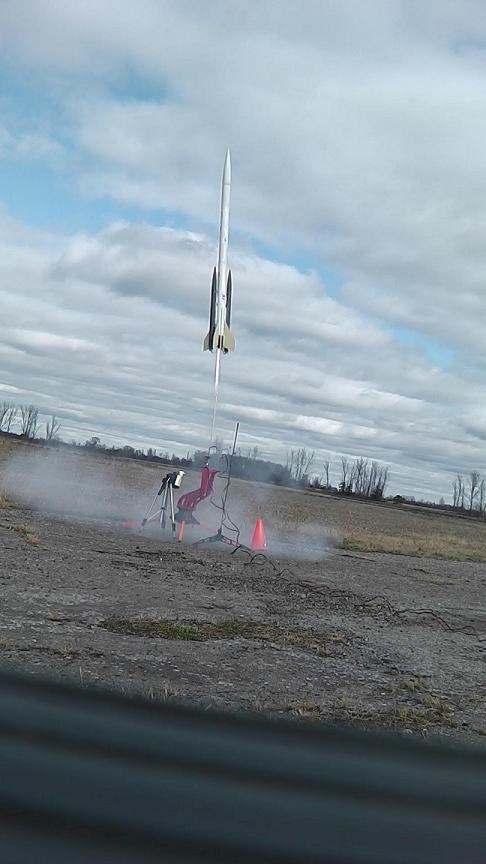
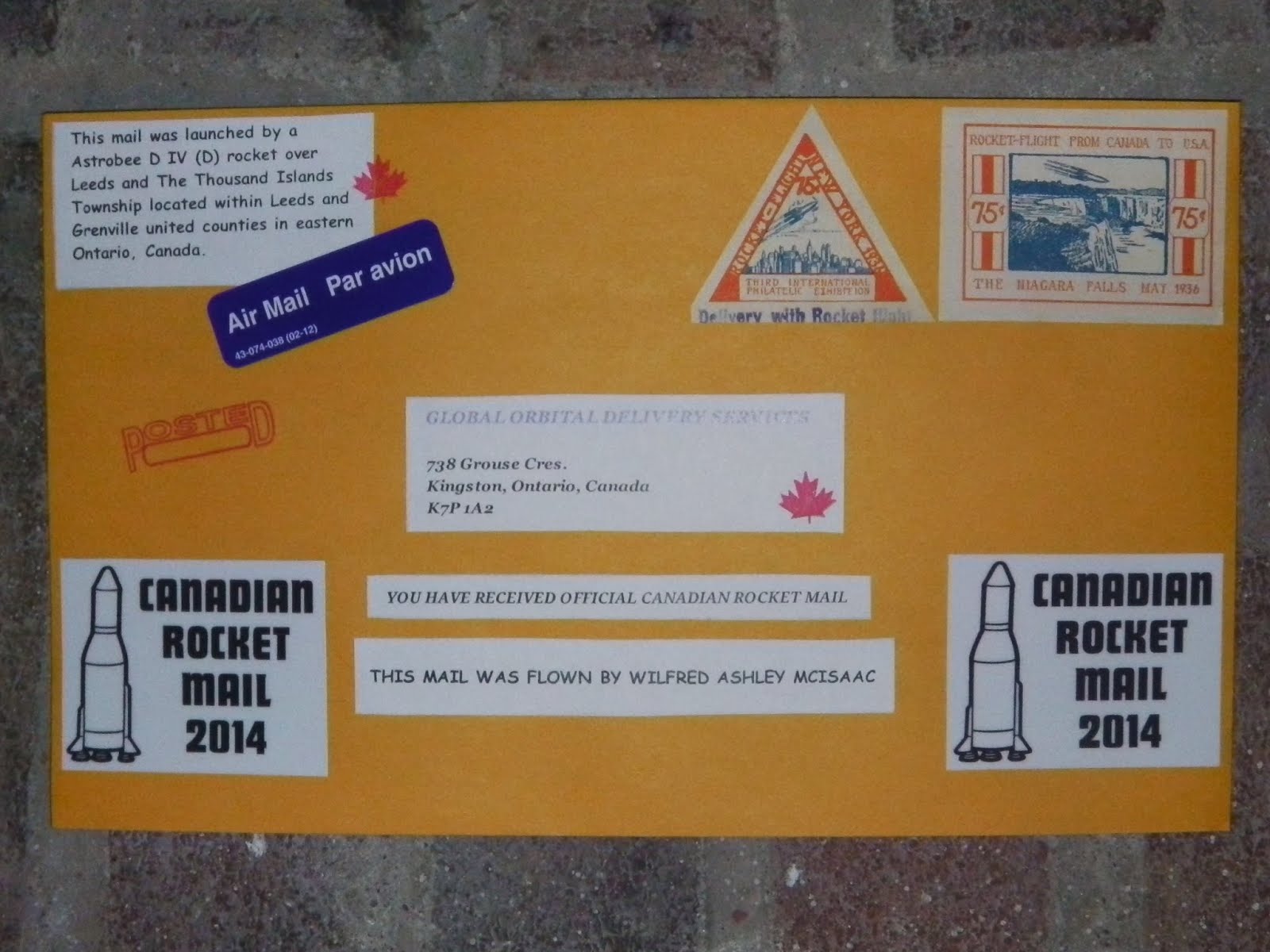
(Above left) The Astrobee D IV high-powered rockets inaugural test flight took place on November 6th, 2012, and flew twelve covers on board.  The upper stage as well as the integral side boosters were inert.  (Center) One of twelve mail covers to fly inside the second stage of the new and improved Astrobee D IV (D) rocket scheduled to launch in the spring of 2014.  (right)  A variety of Gerhard Zucker postage stamps from 1936 (photo courtesy Gemada Stamps).

Wilfred Ashley McIsaac

      A high-powered rocket mail program that began back in October of 2011 from an airfield in eastern Ontario is preparing its fifth and final rocket launch for the late spring.   Wilfred Ashley McIsaac,  the rocketeer behind the flights,  has already launched and successfully recovered the entire collection of Gerhard Zucker 1936 ‘First Canadian Rocket-Flight’ postage stamps  in his four previous flights dating back to 2011.   
       A variety of launch vehicles and payloads have also been flown in the program including;  the ARCAS scale rocket. the Astrobee D scale rocket,  and McIsaac’s modified versions the Astrobee D III, and the Astrobee D (IV) series of rockets.  The latter being the 2 ½ stage Astrobee D IV (D) now preparing to fly in late March.   
     Payloads consisted of;  mail, flight cameras,  science experiments, on board computers, and even a signed petition to ‘Help Save The Canadian Air & Space Museum’  located in Downsview Park, Toronto.  The Astrobee D flight on May 11th, 2012, launched the ‘Astrologger 54’ electronics package which housed two on board flight computers, shock resistant liner,  and even a cooling system that  circulated the air around the module before venting it back outside.  The mail was in a separate compartment above the electronics bay.  
     Of the Four flights already launched and including the one planned for the spring, forty-three covers have or will be flown as well as forty-nine Gerhard Zucker 1936 Canadian Rocket-Flight postage stamps.   Some of these Covers can still be purchased online at Gemada Stamps.   A large portion of funds collected to date from Internet sales has been contributed  to worthy causes such as The Arthritis Foundation while back in 2011 a small donation was made to ‘Help Save The Canadian Air & Space Museum’ on behalf of the program.  McIsaac suffers from rheumatoid arthritis as well as a gimpy left ankle following two major reconstructive surgeries.  
   The final launch will fly twelve covers across an old World War II relief airfield located just outside the small town of Gananoque, Ontario, in The Thousand Islands.  The Astrobee D IV (D) weighs three and a half pounds and stands five feet, seven inches tall with a 2.5 inch diameter.  It is the only multiple stage rocket to fly in the program with the upper stage powered by a one of a kind outboard black powder motor adding 5.4 pounds of extra thrust to the rocket.   The first stage and ½ or main booster of the Astrobee D IV (D)  is controlled by a single sustainer composite motor along with two integral black powder side boosters programmed to ignite shortly after lift-off.    The Three solid fuel motors powering the first stage are the rockets muscle and will combine for over forty pounds of thrust pushing the rocket to an approximate altitude of over 12oo feet.    
    Electronics Bay #1 (EB1) is the rockets main flight computer and the brains behind the flying machine.  It will be secured inside the interior of the nose cone while the mail covers will be placed in a partition near the rear of the upper stage.   A test flight of the 1 ½ stage Astrobee D IV mark 3 rocket on October 17th was a resounding success however a variety of modifications have been made to the launch vehicle following the flight, thus accounting for the new (D) designation.   
      A second flight computer designated Electronics Bay #2 (EB2) is situated inside a small compartment at the aft end of the main booster.   Two on board miniature light weight cameras will also be along for the ride  recording critical video of the twin side booster ignition in the first stage and the backup ejection charge inside the Recovery Systems Bay in the second stage that will help separate the two halfs at or near apogee.

Gerhard Zucker’s Canadian Rocket Flight Stamps take flight After 75 Years On The Ground

       During the early 1930s a German engineer and businessman named Gerhard Zucker  became involved in a series of ill-fated rocketmail launches across Europe including England before the Gestapo, under Adolf Hitler's orders,  placed him under arrest and jailed Zucker indefinitely.
    At the 1936 Third International Philatelic Exhibition in New York City, Zucker (who remained in custody in Germany) relied on a friend,  Karl H. Hennig, Sr.,  to display his stamps, covers, and cachets in booth 77 at the Grand Central Palace on Lexington Avenue in Manhattan.  The ‘Rocket-Flight’ postage  flown years later in Wilfred Ashley McIsaac’s program was among the merchandise at the exhibit.
       An interpreter working in the booth at the time later confirmed a launching rack as well as one of Zucker’s rockets were also on public display.  The same person admitted Hennig had even attempted to purchase a permit to launch the rocket but simply ran out of time.  In the end however the German refused to promote the collection through print or radio out of fear fear of Nazi reprisals and kept a low profile during his stay in the United States.   Zucker’s dreams of launching rocket mail on North American soil were never realized while the Canadian Rocket-Flight stamps disappeared into obscurity for three quarters of a century.  
    No known rocket flights in Canada had ever been successfully flown and recovered using official Canadian rocket mail stamps on board until October 31st, 2011 when McIsaac  launched the 1936 Gerhard Zucker ‘First Canadian Rocket-Flight’  postage stamps 75 years after they were created for the New York exhibit.    The story has since garnered interest from around the international philatelic community with articles in Stamp Magazine, Canadian Stamp News, and The Canadian Aerophilatelist to name just a few.
   The fifth and final launch of Wilfred Ashley McIsaac’s rocket mail program will take place some time in the spring at the Gananoque Airport in eastern Ontario.  “The rocketport” as McIsaac calls it,  has been home to his four previous rocket mail flights.  

Sources:   
The Air Mails Of Canada and Newfoundland, A Volume in the Sixth Edition of the American Air Mail Catalog, copyright 1996.   

Canadian Rocketmail Summary 2011-2014, wilfred Ashley McIsaac

'My Own Private Rocket Program'  Review, 2010-2013, wilfred Ashley McIsaac


Friday, 20 December 2013

THE ORBITING DEAD

           GLOBAL ORBITAL DELIVERY SERVICES  
                                                                        presents

                    THE ORBITING DEAD


By the year 2075, miniature memorial satellites named ‘GODSATS’, carrying the remains of the dead inside, will forever orbit planet earth in clusters commonly referred to as celestial graveyards.  (creative nonfiction)                                                                         


(above left)  A young child and his grandfather look up at the night sky where their loved ones remains are encased in memorial satellites named GODSATS which endlessly circle the globe in large numbers referred to as celestial graveyards.  (above right)  By the year 2075 these celestial graveyards will be observed silently moving across the nights sky in a cosmic death dance lasting epochs.  


05/27/2075
California

      “Grandpa is it time yet”   a young boy named Tommy cries out from the backyard of his southern California home just minutes after the sun has set on a clear night in the year 2075.   He is around nine or ten years old  and stands precariously on a shaky picnic table hoping the height advantage will make a difference.   Straining his neck he incessantly looks up at the ever darkening sky.   After being ignored he tries again, “I think he’s coming….hurry pa”  this time with more vigor in his voice.   
      Seconds later an elderly man rushes out of the back patio door while stopping for a brief moment to close the screen door behind him.  In his rush Tommy had obviously forgot to close it.  The  man is carrying two sets of peculiar dark colored eye-wear.  The boy snaps his head away from the sky for only a brief second making sure his Grandpa has not forgotten anything.  “I’m coming Tommy, I’m coming”  the old man finally responds looking up at his anxious grandson.   “Hurry, hurry”  the boy insists reaching out his hand while maintaining his balancing act on the oscillating picnic table.  Regardless of all of this, Tommy remains completely focused on the same patch of western sky.  All of a sudden faint star like objects begin appearing  just above the horizon and  are tracking across the sky  from west to east.  They are difficult to see however with the naked eye.  
       The young boy snatches the glasses from his grandpa’s grasp and places them over his eyes like you would a regular pair of sun or 3D glasses.  His Grandfather scrambles to do the same.   “That’s much better”  Tommy says as he adjusts the eye wear.   Seconds later, “Here he comes”   the boy confirms his earlier observation with now two set of eyes gazing towards a group of what looks like slow moving stars arriving in formation from the west.  “I see him!” Tommys grandfather enthusiastically shouts out,  “and his mother is right behind him”  a long pause follows while the boy seems to be at a loss for words.   
     Tommy takes off his eye-ware and begins rubbing his eyes.   He peers down at his Grandfather who he now towers over while standing on the three and a half foot high table.  “Grandpa, when I die will I be up there with my dad and grandma for eternity.”  the boy asks in a soft tone hoping to be reassured.  His grandfather removes his glasses and looks up at his grandson “One day son we will all be satellites of the earth,.”  The two exchange smiles before putting their eye-wear back on and return to following the ever growing cluster of moving lights streaking across the nights sky.

 
    As time goes on and spaceflight becomes more affordable to people everywhere,  the final resting place of loved ones will not be six feet under,  but thousands of miles above in the opposite direction.  In the year 2075 cosmic tombstones orbiting the earth in large clusters referred to as ‘Celestial Cemeteries’ will become a popular final resting place for almost everyone on planet earth who passes on.
    In recent years companies such as SpaceX have flown the remains of several deceased celebrities on board their Dragon spacecraft including legendary Star Trek creator Gene Roddenberry.  After the flight Roddenberry’s ashes would have been removed from the capsule and handed back to his surviving family members.  Most likely his remains were placed in an urn and displayed over a fireplace or somewhere special where he can be remembered by friends and family.  If given the opportunity however,  I’m sure Roddenberry would have preferred to remain up in space for epochs while circling his home planet in a seemingly endless cosmic death dance.   
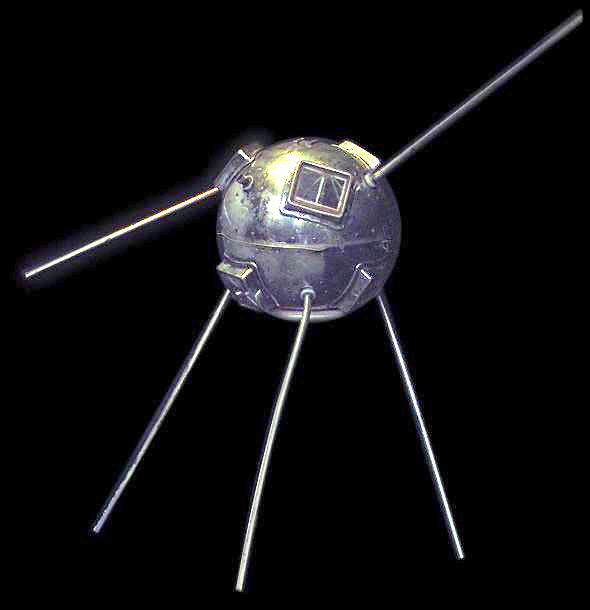
   These future memorial satellites, also referred to as ‘GODSATS’ (short for Global Orbital Delivery Satellites), will have strong reflective properties similar to Sputnik, the first earth satellite launched in 1957 by the former Soviet Union.   Sputnik was an 184 pound glimmering silver sphere around the size of a basketball.  When this miniature socialist intruder flew over parts of the United States it was tracked by anxious Americans on the ground using the aid of binoculars or a small telescope.  
     By the year 2075 anyone looking up at a clear night sky may be treated to the sight of hundreds or even thousands of shiny cosmic tombstones orbiting the planet in clustered or grouped celestial graveyards eerily moving in silence across the heavens.  The memorial satellites will come in many different shapes and sizes including an assortment of colors with varying degrees of brightness.  Private aerospace companies including SpaceX and Virgin Galactic will safely jettison these tiny satellites during routine trips to orbit.  Family members may also be on board the spacecraft taking part in a remembrance service just minutes before their loved ones are ejected into the vacuum of space thus becoming a permanent moon or satellite around planet earth.  
     Using the example at the beginning of this article with Tommy and his Grandfather,  family members and friends of the deceased would have access to special aids or tracking devices allowing them  a clearer view while assisting them in identifying their loved ones memorial marker as it streaks across the sky.   
       Like in graveyards around the world today,  cosmic tombstone will also compete against one another for attention using bigger and brighter ‘GODSATS’ for everyone to see.   These ubiquitous space urns will alter in size from that of a basketball, to as little as a tennis ball.   
    Other options or funeral packages will allow the customer to select specific mission profiles or orbital velocities ranging from highly elliptical orbits to circular ones.  Altitudes can be maintained anywhere from Low Earth Orbit (around 200 miles) or as far out as geosynchronous/geostationary orbit or 35,786 kilometers above earth.  With the later the GODSAT will forever remain above the same patch of sky mimicking communication satellites.  

     The future holds many surprises including what will happen to all of us after we die. The great Russian rocket pioneer Konstantin Edvardovich Tsiolkovsky believed gravity imprisoned the spirit and that a person, alive or dead,  who one day had the ability to escape the grasp of this invisible and menacing force, would be free to wander the universe for all eternity.  
     Perhaps by the year 2075,  heads will no longer bow down to honor the deceased as they rest in peace under six feet of topsoil, but raised up towards the heavens while the souls of the dead float free of earth’s gravity and cosmic tombstones are on display for all the world to see.  A profound resting place worthy of a galactic king or queen.     


Wilfred Ashley McIsaac


Saturday, 14 December 2013

ADVANCED ROCKETS AND SPACECRAFT MAY SAVE YOUR LIFE ONE DAY IN THE NEAR FUTURE

ADVANCED ROCKETS AND SPACECRAFT MAY SAVE YOUR LIFE ONE DAY IN THE NEAR FUTURE


Move over space tourism, in the future advanced rockets and spacecraft will have more important tasks to keep busy with besides becoming a cosmic tour train.


Wilfred Ashley McIsaac
GLOBAL ORBITAL DELIVERY SERVICES


    As aerospace technology including the advancements of rockets and spacecraft move forward at a seemingly unstoppable pace,  the future in express services to the most remote locations on planet Earth will become shockingly fast.  While most private aerospace companies are now concentrating on sending paying customers into low earth orbit; others, such as Global Orbital Delivery Services,  are looking for better ways of using this future technology for more practical purposes on planet earth.
     From sending medical supplies to impoverished nations suffering from a natural disaster, drought, or some other catastrophe; to shipping out emergency spare parts or critical operating equipment for big industry.  
    Yes, the list of what a autonomous descending spacecraft can accomplish, one which can lift off and land anywhere on the planet in under an hour, is long indeed.  Here are just three very dramatically different examples of why rockets in the future will improve life on our planet while flying at or below low earth orbit.


Disaster Relief
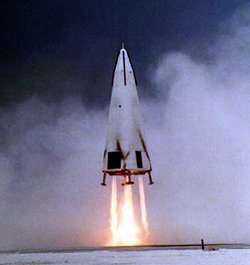
    The powerful typhoon that has recently devastated parts of the Philippines (left pic above) was a reminder to all of us of how quickly conditions on our planet can change in a very short time and paralyze a country within hours.   In the future behind companies such as ‘XCOR Aerospace, Spacex,  Virgin Galactic, etc; and through the support of World Health Organizations including Unicef, help can arrive (right pic) almost immediately from anywhere in the world carrying important medical supplies, food, and water.
      Imagine the surprise from victims of such devastation when within minutes, space capsules, in a controlled descent, begin landing around the devastation carrying life saving supplies.   


Big Industry


     The same express analogy also applies to the shipment of critical operating supplies to big industry such as oil refineries.   Imagine a giant rig in the South Pacific suddenly shut down because of a critical part or instrument breaking down.   With no back-up on board and civilization thousands of miles away,  it would normally take one or two days to have the necessary equipment or replacement parts shipped in to resolve the situation.   As precious time goes by the operating company stands to lose millions of dollars.  
     With the autonomous controlled descent of a rocket's upper stage in the not too distant future,  the emergency supply vehicle can land on the deck of any ship or oil rig within a very short time of being called into action.  Like a helicopter but with no pilot and no propellers.   Instead of losing precious time waiting for conventional transportation currently in use,   the workers watch as within hours or even minutes a rocket lands on deck carrying new equipment.  The employees are back to work almost immediately.  


Buried In Space
   While this revolutionary technology will be able to save countless amount of lives from around the world,  it will also have the capability of giving people a funeral and final resting place suitable for a galactic king or queen.  Space urns carrying the remains of loved ones will be jettisoned from low earth orbiting spacecraft while the deceased begin quietly circling the planet for hundreds if not thousands of years inside memorial type satellites no bigger than a tennis ball.   
    In recent years companies such as Spacex have flown the remains of several deceased celebrities on board their Dragon spacecraft including legendary Star Trek creator Gene Roddenberry.  If given the option these same people would rather remain up in space for eternity while they endlessly loop around their home planet in a cosmic death dance.
     Perhaps,  some of these memorial satellites will have strong reflective properties which at night can be seen from the ground.  In time an astronomer or anyone for that matter looking up at the heavens may see hundreds or even thousands of these cosmic tombstones orbiting our planet in celestial graveyards eerily moving across the night sky.  


     So the future is looking up (sort of speak) for the aerospace community in more ways than one.   Besides space tourism and trips to the moon and mars,  spacecraft relegated to low earth orbit may surprise you while one day saving your life or morbidly displaying your physical remains for all the world to see.   


     Perhaps,  some of these memorial satellites will have strong reflective properties which at night can be seen from the ground.  In time an astronomer or anyone for that matter looking up at the heavens may see hundreds or even thousands of these cosmic tombstones orbiting our planet in celestial graveyards eerily moving across the night sky.  


Friday, 13 December 2013

ROCKET MAIL PROGRAM ENDS IN EASTERN ONTARIO WITH FINAL FLIGHT

ROCKET MAIL PROGRAM ENDS IN EASTERN ONTARIO WITH FINAL FLIGHT


On Tuesday the final flight of Wilfred Ashley McIsaac’s Canadian high powered rocket mail program blasted off from the Gananoque airport in eastern Ontario carrying mail with 1936 Gerhard Zucker ‘First Canadian Rocket-Flight’ postal stamps attached.

November 7th, 2012

     A nearly six foot high powered test rocket lifted off from the Gananoque airport in eastern Ontario on Tuesday carrying a variety of electronics (EB1 and EB2 [electronics bay 1 and electronics bay 2] in nose cone and booster) as well as twelve pieces of mail with rare 1936 ‘First Canadian Rocket-Flight’ postal stamps attached.
   The 3.42 pound Astrobee D IV was a revised Astrobee D high powered scale rocket originally produced by Aerotech in the United States.  A long list of changes were made to the launch vehicle including the addition of two integral black powder side boosters which were to give the rocket almost forty pounds of thrust.
    Unfortunately during Tuesday’s launch attempt the twin boosters failed to ignite followed by an onboard backup system malfunction.  A similar incident took place on June 29th to a Astrobee D III rocket during the third test flight of the program when three strap-on boosters didn’t ignite and the rocket crashed into a cornfield.  On Tuesday’s launch however the Astrobee D IV remained stable throughout the entire twenty-five second test flight confirming the rockets center of gravity and center of pressure were redesigned correctly. Although the altitude was much lower than expected (prior to flight 2000 feet was calculated and only near 800 feet was reached) the 1 and ½ stage rocket did release it’s payload section (Canadian mail) on time while the recovery system returned the upper stage across the airfield shortly downrange.   The booster landed not far from the payload section after making a hard landing due to a parachute malfunction.
   Tuesdays launch was the final flight of a Canadian rocket mail program dating back to October 31st, 2011 with the ultra successful single motor ARCAS high powered rocket made by Aerotech.   According to the ‘Air Mails Of Canada And Newfoundland’ these mail flights are the first and only in Canada’s history to carry official Canadian rocket mail postal stamps on board and later recovered safely.   Back in 1936 a German businessman named Gerhard Zucker produced the first and only series of stamps intended to be launched inside a rocket in Canada however Zucker was arrested by the Gestapo before he could make the trip across the Atlantic Ocean himself.  As per official record the stamps were never launched in this country until 2011 when rocket experimenter Wilfred Ashley McIsaac commenced his private rocket mail program seventy-five years after the fact near the Thousand Islands in eastern Ontario.  Following Tuesday's launch attempt most of the previously unflown Canadian rocket mail stamps from the 1936 Zucker collection have now made a trip inside one of McIsaac’s rockets.
     Since the programs inception most of the nicely decorated mail covers designed by McIsaac himself have been auctioned off on Ebay by a company on the west coast of the United States named Gemada Stamps.  11 of the 12 covers from the November 6th test launch will make the same trip south of the border and should be available on Ebay through Gemada Stamps before Christmas.  McIsaac, who suffers from long term health issues including rheumatoid arthritis will donate $200 to the Arthritis Foundation on behalf of the Canadian rocket mail program.   In the future more test flights are expected to take place with the three motor Astrobee D IV while the rocket's payload bay will only carry ballast weight.


(left) Wilfred Ashley McIsaac shows off his precious cargo following Tuesdays rocket mail flight in eastern Ontario.   The letters were later officially cancelled at the nearest post office in Gananoque,Ontario. (right) The upper payload section was returned to the ground safely under a bright orange parachute.    Pictures provided by my Father, Rennie McIsaac.


A short circuit in the booster ignition system may have been the cause of the integrated side booster malfunction.  The test flight did prove however the Astrobee D IV was stable and that future launches could continue.